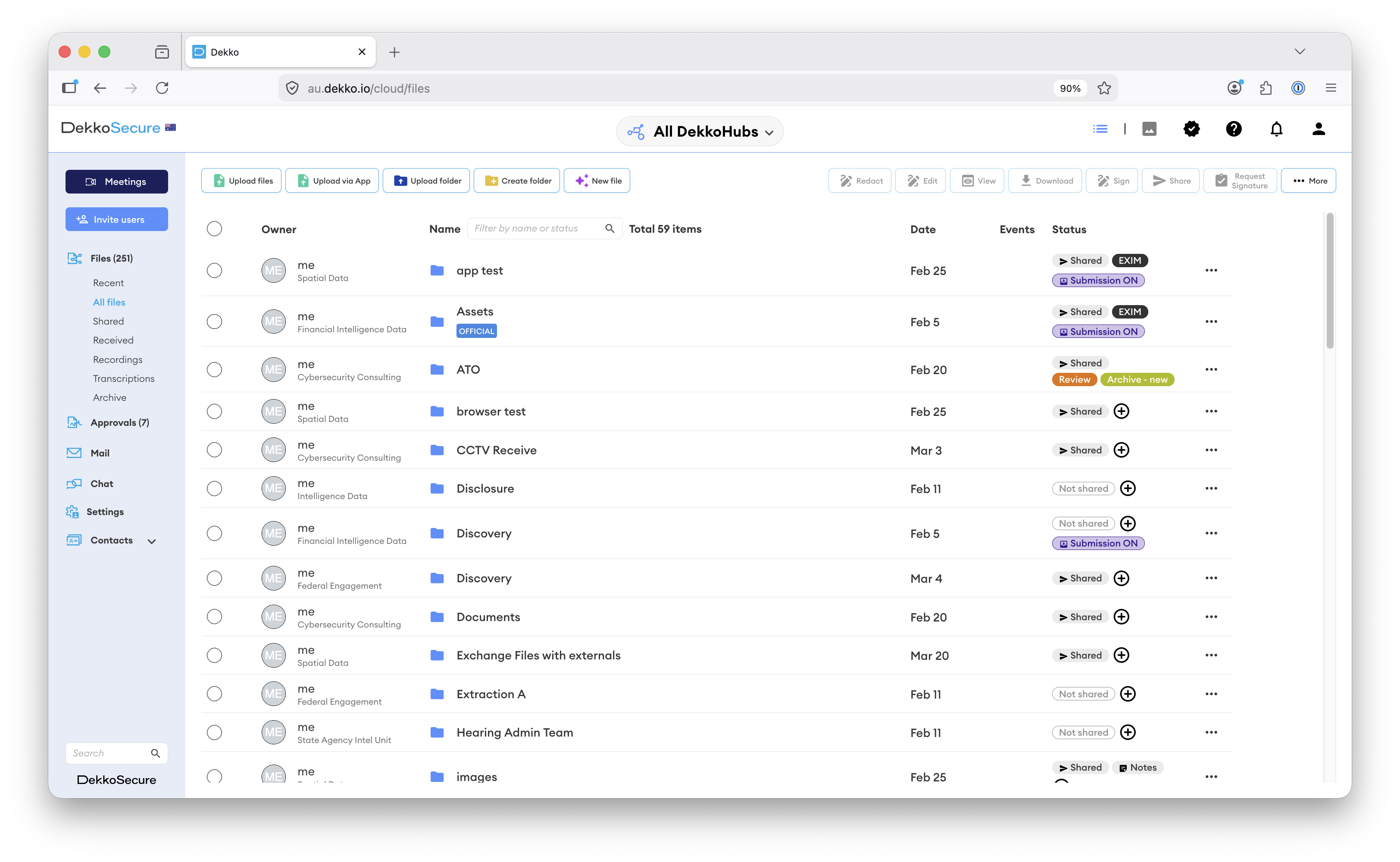
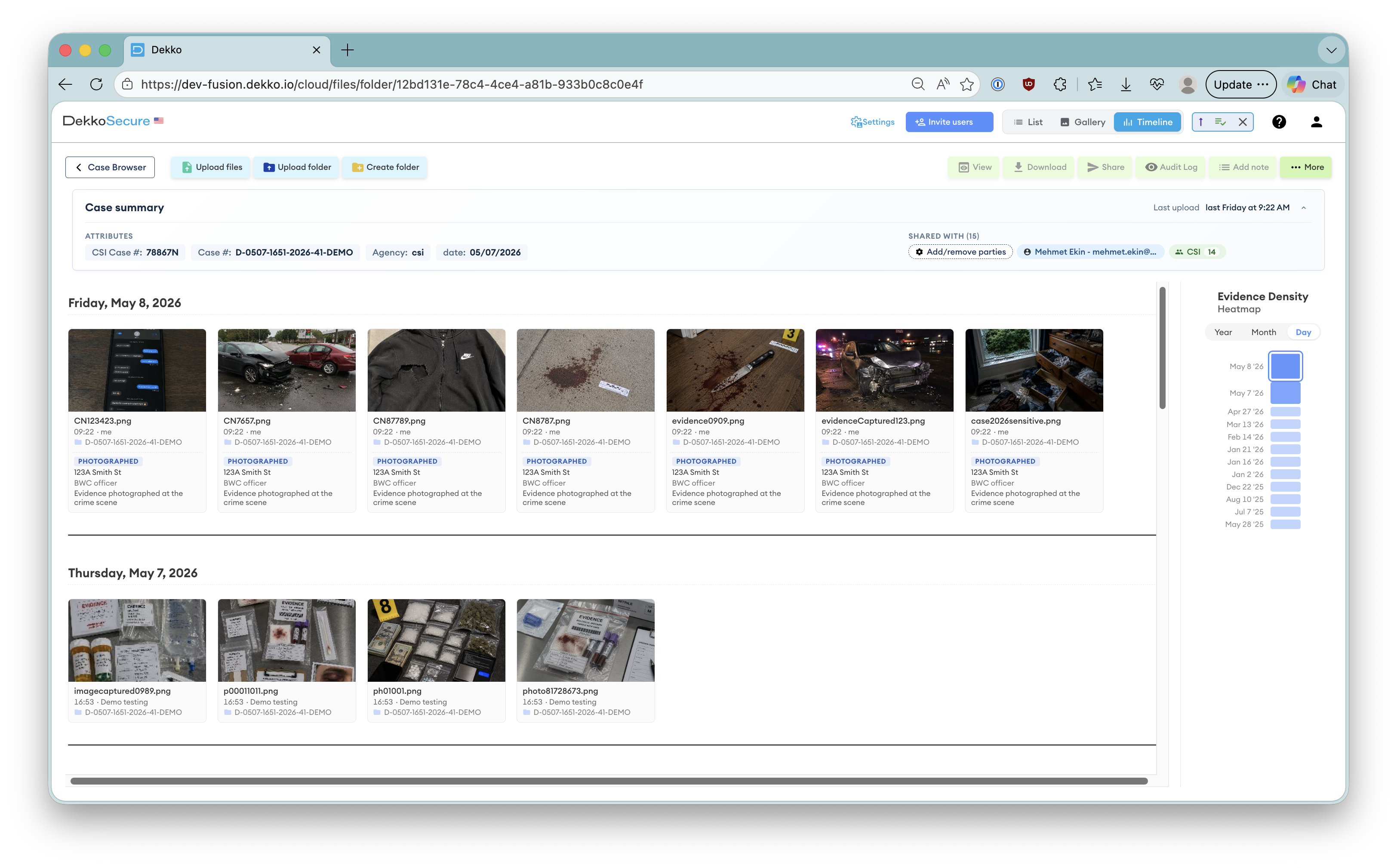
Four sovereign environments, one zero-knowledge architecture.
DekkoSecure operates separate, isolated hosting environments in Australia, the United States, Canada, and Switzerland. Each environment stores and processes data exclusively within its own jurisdiction.
With zero-knowledge end-to-end encryption, the content shared through DekkoSecure never leaves its designated jurisdiction and cannot be accessed by DekkoSecure, infrastructure providers, or any third party in any jurisdiction. A Zero Trust model reinforces this architecture across all collaboration features, enforcing continuous authentication, granular Hub-based permissions, and strict SSO-driven identity controls so that only verified users can access specific data and actions.
Together, these layers enable sovereign cloud file sharing and support data sovereignty for government and regulated industries.

How DekkoSecure delivers data sovereignty
DekkoSecure's data sovereignty model is not a configuration option or a hosting preference. Each jurisdiction runs as a fully separate environment with its own infrastructure, its own data stores, and its own access boundaries. Data created in the Australian environment stays in Australia. Data created in the US environment stays in the United States. There is no cross-border replication, no shared backend, and no centralised data layer that spans jurisdictions. These controls keep cross-border data sharing secure and enable sovereign file sharing within each jurisdiction.
This separation is reinforced by DekkoSecure's zero-knowledge encryption architecture. All content is encrypted on the user's device before it reaches the platform, and only the intended recipients hold the keys to decrypt it. Even within a sovereign environment, DekkoSecure as the service provider cannot access or decrypt customer data. This provides two independent layers of data protection: jurisdictional containment through sovereign hosting, and cryptographic containment through zero-knowledge encryption.
What is data sovereignty and why does it matter for file sharing?
Data sovereignty is the principle that data is subject to the laws and governance of the country where it is stored and processed. For government agencies, defence organisations, law enforcement, and healthcare, data sovereignty is not optional. For these highly regulated industries it is a legal and policy requirement that determines which platforms can be used to handle sensitive information.
Data sovereignty is often confused with data residency. The distinction matters because hosting data in a local data centre does not guarantee sovereignty if the platform provider is headquartered in another country or subject to foreign legal instruments.
Means data is stored in a specific location. A residency commitment alone does not address who can compel access to that data under foreign law.
Goes further. It means the data is subject to the legal jurisdiction of that location and is protected from access by foreign governments, foreign courts, or foreign intelligence frameworks.
This is why provider headquarters and controlling law matter. A platform that stores data in Australia but is operated by a US-based company may still be compelled to produce that data under instruments such as the US CLOUD Act, which can compel US-headquartered providers to disclose data held overseas.
DekkoSecure addresses this in two ways. Each sovereign environment is operated within its own jurisdictional boundary. The zero-knowledge encryption model means that even if a legal demand were made, DekkoSecure has no technical ability to decrypt or produce customer content in any jurisdiction.
Where does DekkoSecure operate sovereign environments?
Each environment hosts data exclusively within its own jurisdictional borders, supports the regulatory frameworks specific to that jurisdiction, and operates with no cross-border replication.
Australia
Hosts data exclusively within Australian territory. Independently IRAP assessed at PROTECTED level and supports agencies operating under the PSPF, ISM, and Australian Privacy Act. Serves Australian government agencies, defence supply chain organisations, law enforcement, and healthcare providers.
United States
Hosts data exclusively within US territory. Supports organisations operating under CJIS Security Policy, HIPAA, and ITAR requirements. DekkoDEMS, DekkoSecure's digital evidence management system, is hosted in this environment and serves US law enforcement agencies and justice departments.
Canada
Hosts data exclusively within Canadian territory. Supports organisations operating under GO-ITS 25.21, ITSG-33, and Canadian federal and provincial privacy legislation including PIPEDA and provincial equivalents.
Switzerland
Hosts data exclusively within Swiss territory and provides a European data sovereignty option for organisations that require data residency within Europe.
How does zero-knowledge encryption strengthen data sovereignty?
Traditional data sovereignty relies on hosting location alone. If data is stored in Australia, it is considered sovereign to Australia. But if the platform provider can access that data in plaintext for internal operations, support requests, or under legal compulsion, then the sovereignty guarantee has a structural weakness.
DekkoSecure's zero-knowledge architecture removes this weakness. All content is encrypted on the user's device using AES-256 and ECC-384 before reaching the platform. DekkoSecure does not hold decryption keys and has no technical means to view, search, or process customer content in plaintext. This applies to all four sovereign environments equally.
The result is that data sovereignty in DekkoSecure is enforced at two levels: geographically through isolated sovereign hosting, and cryptographically through zero-knowledge encryption.
Data sovereign file sharing for government and regulated industries
DekkoSecure's sovereign hosting model supports organisations that are required by law, policy, or contractual obligation to keep data within specific jurisdictional boundaries.
Government agencies required to store and process data within their national territory under protective security frameworks.
Defence supply chain organisations exchanging classified or controlled technical data under AUKUS, ITAR, or national defence procurement rules.
Law enforcement agencies sharing digital evidence across jurisdictions while maintaining sovereign control of each agency's data.
Healthcare organisations subject to data localisation requirements under national health privacy legislation.
Regulated industries including financial services, legal, and professional services where client data confidentiality and jurisdictional compliance are contractual requirements.
Contact DekkoSecure
To discuss data sovereignty requirements for your organisation or to learn more about DekkoSecure's sovereign hosting environments, contact the team.